Tobacco Smoke Yield (TPM, Tar, Nicotine) Laboratory Measurement Technical Parameters and Standard Methods
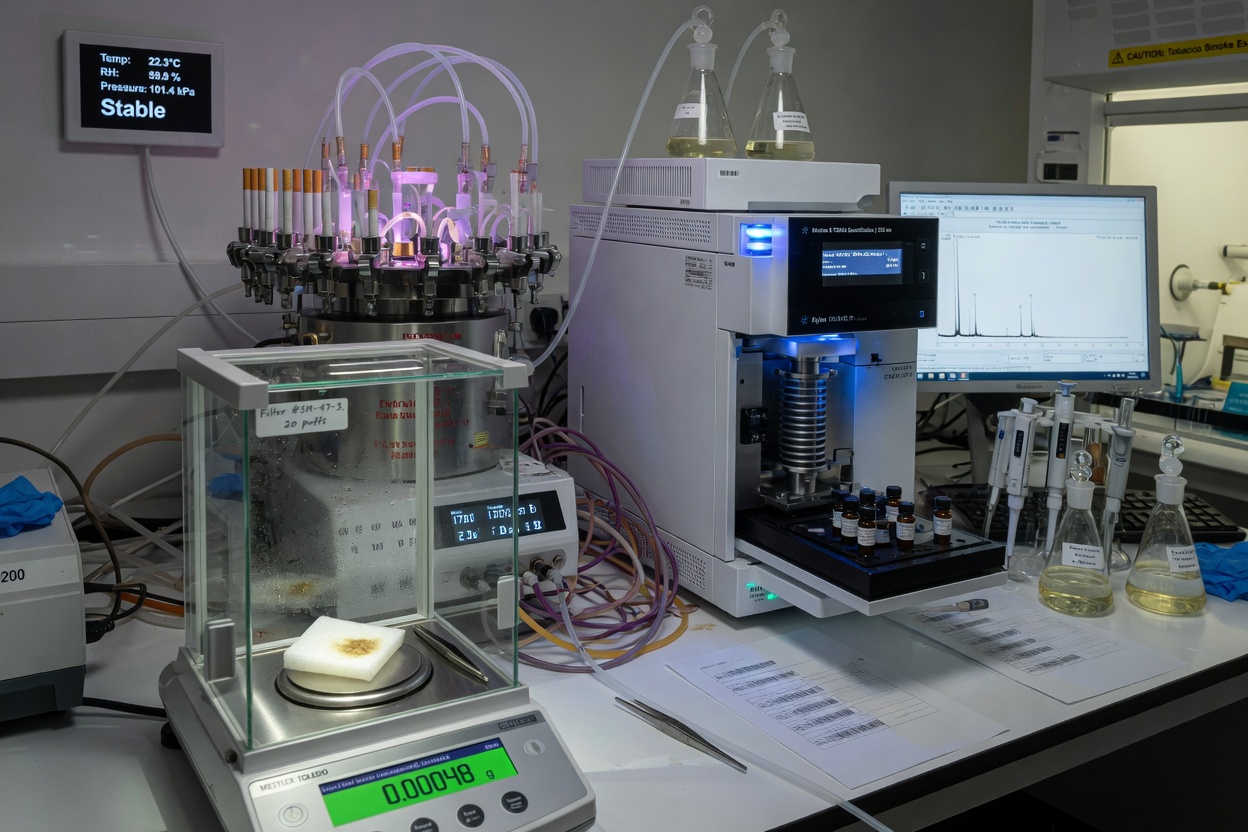
Introduction: The "Numbers Game" in the Laboratory
In the field of tobacco quality control, the precision and consistency of measurement results are not merely numbers on a laboratory report, but the lifeline for product compliance and research direction. Whether it is strict control over tar content or precise tracking of nicotine delivery, any minor environmental fluctuation or equipment deviation can be amplified into a significant quality trend in the final statistical analysis. The current challenge in the industry is not "whether we can measure," but "how to achieve extremely high measurement repeatability under the interference of high variability."
Core Measurement Logic: From Standard Puffing to Component Capture
The essence of smoke component measurement is to simulate human smoking behavior and physically or chemically capture the generated smoke. This process is governed by strict standard protocols such as ISO 4501 or GB/T 17376.
1. Standardized Constraints of Puffing Conditions
Any high-precision measurement begins with the perfect replication of the "puffing process." Standard puffing parameters include:
- **Puffing Frequency**: Typically 1 puff/second or 2 puffs/second. Fluctuations in frequency directly affect the residence time of smoke in the filter.
- **Puff Flow Rate**: Standard values are 50 mL/puff or 55 mL/puff. The linearity of the flow controller must be controlled within ±1%, otherwise it will lead to changes in smoke density, thereby affecting the TPM calculation.
- **Environmental Temperature and Humidity**: This is the most easily overlooked variable in the laboratory. The standard requires testing under conditions of 23℃ ± 1℃ and relative humidity of 50% ± 5%.
2. TPM and Tar: The Precision Art of Gravimetric Method
TPM (Total Particulate Matter) and tar measurement mainly employ the Gravimetric Method. An automatic smoking machine passes the smoke through a specific filter (such as glass fiber filter paper or cellulose acetate filter tip), and then a precision balance measures the weight difference before and after.
**Technical Pain Points and Practical Experience**:
In actual operation, I have encountered multiple quality deviations regarding "abnormally high tar values." After investigation, the problem was not in the flow rate of the smoking machine, but in a slight loss of control over environmental humidity. When the laboratory humidity fluctuates above 55%, the filter paper exhibits strong hygroscopicity. Even after thorough constant temperature and humidity drying before weighing, the instantaneous moisture absorption of the filter paper during transfer can cause a systematic positive deviation of 2%-3%. Therefore, in high-precision measurement, a stricter "constant temperature and humidity chamber pretreatment" process must be introduced, rather than relying solely on laboratory air conditioning.
Technical Parameters and Selection Logic of Mainstream Measurement Equipment
1. Automatic Smoking Machine
The smoking machine is the "heart" of the entire system. When selecting, one should not only look at the brand but must pay attention to the following core parameters:
- **Pressure Compensation Capability**: During long-term operation, the pressure stability of the pump determines the constancy of the puff flow rate.
- **Temperature Control Precision**: The temperature control inside the puffing chamber needs to reach ±0.1℃. If the temperature difference is too large, condensation of smoke before entering the filter will change the physical morphology of particulate matter.
- **Automation Level**: Equipment that can automatically complete puff interval control, filter tip replacement, and pressure self-calibration can greatly reduce random errors introduced by human operation.
2. Nicotine Analysis System: Precision Strike of Chromatography Technology
Nicotine measurement enters the field of chemical analysis, with the mainstream method being High-Performance Liquid Chromatography (HPLC).
**Key Technical Indicators**:
- **Mobile Phase Stability**: Nicotine exhibits a certain polarity in a mobile phase containing buffer solution. pH deviation of the mobile phase directly leads to retention time drift.
- **Detection Wavelength**: Typically set at 361 nm. The linear range of the detector must cover the full range from low concentration (<0.1 mg/cigarette) to high concentration (>2.0 mg/cigarette).
- **Extraction Efficiency**: The extraction process of nicotine (usually using acidic aqueous solution or organic solvent) is thestep with the largest error.
**Expert Advice**:
When processing high-concentration nicotine samples, do not attempt to solve the problem through simple dilution. I prefer to use the standard "multi-point calibration method" and strictly control the filtration steps after extraction. Once, a batch of samples showed abnormal result fluctuations. The cause turned out to be that during the filtration process, the filter membrane material had a slight adsorption of nicotine, causing the measured value to be about 4% lower than the true value.
"Hidden Reefs" in Laboratory Practice: Pitfall Avoidance Guide
1. The "Invisible Variables" of Consumables
The filter tip is not just a filter; it itself is an experimental variable. Different batches of cellulose acetate filter tips have slight differences in porosity and hygroscopic capacity. When conducting cross-comparison studies, it is necessary to ensure that all tests use the same batch and specification of filter tips; otherwise, this "batch effect" will mask the true differences of the product.
2. The "Maintenance Blind Spot" of Equipment
The sealing of the smoking pump gradually decreases with increased usage time. Many laboratories, during monthly calibration, only focus on flow rate but neglect changes in pressure pulses. An increase in pressure pulses leads to uneven turbulence at the filter inlet, which, when measuring extremely low content components (such as very low tar products), significantly increases the standard deviation (RSD) of the measurement values.
Conclusion: Advancing Toward Higher Precision
The measurement of tobacco smoke yield is transitioning from "compliance measurement" to "precision measurement." With the continuous tightening of global regulatory standards, the core of laboratory competition is no longer the accumulation of equipment, but the mastery of the complex coupling relationship among the four dimensions of "environment-equipment-consumables-human." Only by bringing every tiny variable under controlled range can we capture the true product truth in the ocean of data.